The BACCO Simulation Project: A baryonification emulator with Neural Networks
Nov 30, 2020· ,,,,,·
0 min read
,,,,,·
0 min read
Giovanni Aricò
Raul Angulo
Sergio Contreras
Lurdes Ondaro-Mallea
Marcos Pellejero-Ibañez
Matteo Zennaro
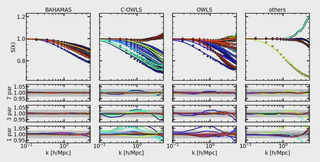 Upper panles: Baryonic impact on the matter power spectrum at z = 0, defined as S(k) = PHydro/PGro, as measaured in hydrodynamical simulations. The solid line represents the best-fitting models otained with our emulator. Lower panels: ratio between hydrodynamical simulations and our model, considering 7, 3, and 1 free parameters
Abstract
We present a neural-network emulator for baryonic effects in the non-linear matter power spectrum. We calibrate this emulator using more than 50, 000 measurements in a 15-dimensional parameters space, varying cosmology and baryonic physics. Baryonic physics is described through a baryonification algorithm, that has been shown to accurately capture the relevant effects on the power spectrum and bispectrum in stateof-the-art hydrodynamical simulations. Cosmological parameters are sampled using a cosmology-rescaling approach including massive neutrinos and dynamical dark energy. The specific quantity we emulate is the ratio between matter power spectrum with baryons and gravity-only, and we estimate the overall precision of the emulator to be 1 − 2%, at all scales 0.01 < k < 5h Mpc−1 , and redshifts 0 < z < 1.5. We also obtain an accuracy of 1 − 2%, when testing the emulator against a collection of 74 different cosmological hydrodynamical simulations and their respective gravity-only counterparts. We show also that only one baryonic parameter, namely Mc, which set the gas fraction retained per halo mass, is enough to have accurate and realistic predictions of the baryonic feedback at a given epoch. Our emulator will become publicly available in http://www.dipc.org/bacco.
Type
Publication
In Monthly Notices of the Royal Astronomical Society
